

I said kaddish for Aysenur Eygi this week. I don’t know if that was an arrogation or a cultural appropriation; I don’t know if Eygi who, after all, was not Jewish, would have been offended, or if she would have accepted my gesture in the spirit intended. I know that it is complicated, but I can only exist in the world as a Jew, and I can only mourn a death, the terrible loss of a woman of great courage, as a Jew. And that means saying kaddish.
I have been reflecting on Eygi’s life and death as I watched President Biden and Vice President Harris tie themselves in knots as they tried to find a way to condemn the State of Israel without substantively changing the US relationship. That, in itself, is a long conversation, but I don’t have the energy for a smack-down with the American exceptionalists on the left who see Uncle Sam behind every evil. My sense is that Washington would like to do something more than wag a finger and send a strongly worded letter but dares not for raisons d’etat.
The machinations of the 21st century state in the pursuit of its “vital interests” are unsurprising, tawdry, and grim. We have been here before and, in some weird spin on eternal recurrence, we will be here again. It might be the President piously and impotently expressing his outrage at the death of another American at the hands of Israeli security forces, or simply the cycle of exasperation and horror that never seems to interrupt the arms shipments. There is nothing to meditate on there; only the bleak cycles of helplessness and hopelessness.
Rather, my thoughts have focused on Eygi’s courage – a courage that I know I do not and never will possess – and its how her death has been narrated in much of pro-Palestinian social media.
Make no mistake; Eygi was a woman of uncommon valor and exceptional commitment. As an activist, and as a witness to the illegal expansion of Israeli settlements in the Occupied Territories, she should be a role model for all of us – especially myself – whose activism never takes us far from the comfort of the living room couch. She literally put herself in the line of fire and in a war zone (even if Israelis deny that the West Bank is, indeed, a war zone). I cannot imagine having that kind of nerve.
Yet, I am disturbed – and more than a little distressed – by the social media predisposition to narrate Eygi as a martyr. We do love our martyrs in social media and popular culture; the person who makes “the ultimate sacrifice” for their cause (providing it is a cause that we espouse) is more than a hero, but some kind of superhero whose life, like Tony Stark in Avengers: Endgame, is both incomparably ennobled and redeemed by this one, irrevocable act of selflessness.
It’s a powerful narrative trope that appears in the epic literature of most of the world’s cultures, from the 300 Spartans at Thermopylae to Roland at Roncesvalles and beyond. Istishhad, self-sacrifice in the service of God, is a supreme act of devotion in Islam. And the calendar of Christian saints is overpopulated with martyrs. I remember, when I was a child, seeing an illustration in a historical picture book of Christians in the Roman arena facing ravening lions. It was a frightening image and, when I asked my father about whether the Romans tortured Jews in that way, he said “God does not want people to die.”
That isn’t quite true, since Judaism has its own stories heroic martyrdom, like Eleazar Avaran of the Maccabees, who (we are told) gave his life heroically spearing a Seleucid war elephant in the belly at the Battle of Beit Zechariah… which subsequently collapsed on him. And there is the story of Masada, where the last holdouts of the Jewish rebellion against Rome committed a mass murder-suicide rather than allow themselves to be captured by Caesar’s legions.
These are stories of martyrdom that I grew up with, even though recent research has shown that the Masada sacrifice almost certainly never happened and even the classical Jewish historian Josephus notes that Eleazar’s act was pointless – the Maccabees lost the battle – and more than likely motivated by pride. Indeed, the Jewish attitude to heroic self-sacrifice can mostly be described as “deeply skeptical.” Consider the commentary in the Second Book of Samuel about the deaths of King Saul and his son Jonathan at Mount Gilboa:
Thy beauty, O Israel, upon thy high places is slain!
How are the mighty fallen!
Sacrifice is something to mourn, not celebrate.
And there is indeed something about the celebration of Eygi’s “martyrdom” that makes my skin crawl. It contained echoes of the beatification of Aaron Bushnell following his self-immolation six months ago that were hard to bear. One social media friend connected the two deaths in a way that seemed consistent with much of the online pro-Palestinian rhetoric but sadly missed the point. And we do miss the point if we focus on Eygi’s death.
We do know that she did not actively seek her own death and, in fact, took steps to remain out of the crossfire when the peaceful demonstration she attended at Beita, a village near Nablus on the West Bank, became increasingly tense. The Washington Post has reported that Eygi and other foreign activists had withdrawn to more than 200 yards from the position held by Israeli security forces. Moreover, the demonstration, in which the Israelis fired live rounds at demonstrators, had already begun to peter out.
We know that, far from putting herself in the crossfire, welcoming the peril that would come her way from an errant round fired by an Israeli soldier. Eygi took reasonable steps to secure her safety and, it appears, was intentionally targeted by the Israeli security personnel. She was assassinated.
Eygi was not a heroic martyr who welcomed death but the victim of Israeli violence. This distinction is crucial because it illustrates the depravity of the State of Israel and the tragedy of her death at its hands. Her courage was not that of the martyr seeking to be remembered for that one great act of sacrifice – and I am convinced that all martyrs are narcissists – but of the advocate anonymously standing up to sanctify life, pursue justice, and heal the world. Had her life not been destroyed by Israeli violence, we might never have heard Aysenur Eygi’s name.
I said kaddish because Eygi is a model for what I believe we should aspire to be.
The mourner’s kaddish is a strange prayer for the dead that never mentions death; indeed, it is not a prayer for the dead at all. Rather, it praises the Creator of the Universe and beseeches him to bestow redemption, love, and abundant peace on the world. Today, many of us choose to conclude it with these words, recited in the ancient Aramaic language:
May He who makes peace in His high places grant peace upon us, all Israel, and all who dwell on earth; and let us say: Amen.
11 September 2024
***
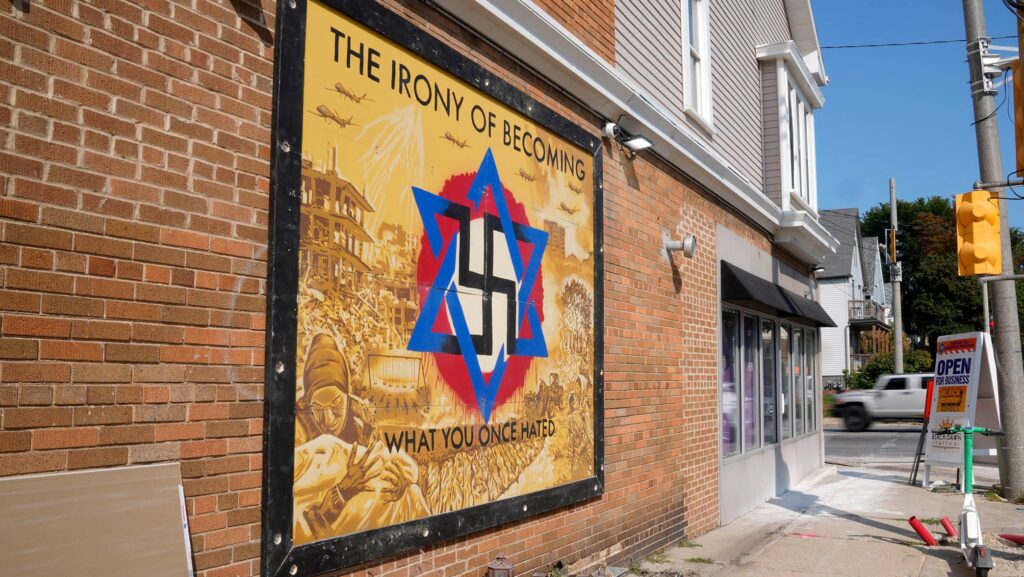
This mural appeared in Milwaukee this week.
It clearly equates the War on Gaza with the Holocaust and the State of Israel with National Socialism. The accusation of “Nazi” has a long history – antiwar activists during the American phase of the Vietnam War deployed it often enough against the US government, supporters of the war effort, and their parents – but I think one must unpack some of the other valences here, particularly with the image of the Magen David morphing into a swastika.
The Magen David is, of course, primarily a Zionist symbol – it really only became pervasive in Jewish life in the 20th century associated with Zionism and it was historically associated with Jewish sovereignty. Having said that, I don’t think that most people are aware of that subtlety, and it is generally regarded as a Jewish symbol. So, while one might read this image in such a way that the “you” (“the irony or becoming what you once hated”) is the State of Israel, or Zionism, I don’t believe that this was the image creator’s intent. I have a strong suspicion that they mean Jews collectively, rather than just the State of Israel.
We have all seen versions of this formula where the “you” is explicitly “Jews.” For example, with the deployment of Hasidic representations of Jews, the use of images of victims of the Shoah, or in the rhetorical construction of “you have become what once sought to destroy you.” (It is worth noting that the Nazis sought to destroy the Jews of Europe, and not the State of Israel, which would not exist until after the Shoah.) The creator of this image has done a pretty good job of mystifying that meaning, but I believe that the meaning is there.
After all, this variant on the formula exists within the existing context of the formula whose rhetorical power derives, to a considerable extent in its repetition. So, in my reading, this image equates the State of Israel and Zionism with National Socialism and accuses Jews collectively of being Nazis. I regard this latter as antisemitic.
The image also equates the War on Gaza with the Shoah, which is what makes it so rhetorically powerful – “you” (the Jews) are doing to Palestinians what the Nazis did to “you” (the Jews). This relates to the deployment of the category “genocide” to describe the State of Israel’s War on Gaza. Whether or not it is a genocide is irrelevant. (I suspect that it is.) What is relevant is that, by categorizing it as a genocide, the Israeli War on Gaza has been equated, in some way, with all genocides – including the Bosnian Genocide, which it certainly resembles.
The Shoah and the Porajmos are, of course, the archetypal genocides (literally, as they were the cases upon which the legal definition of genocide was based), so it seems only natural that one would equate all subsequent genocides with these archetypes, whatever the specifics of each case. So, the Rwandan Genocide was just like the Porajmos, and the Bosnian Genocide was just like the Shoah because they were all genocides and “acts committed with intent to destroy, in whole or in part, a national, ethnical, racial or religious group.”
My problem with this is twofold, but my biggest objection, like Yehuda Bauer (with whom I admittedly have some serious differences), is that the category flattens “genocide” and ignores the specificity of each historical case. (Bauer suggests that the term “genocide” is itself inadequate, but I think that misses the point.)
The truth is that the War on Gaza really cannot be equated, in the specifics, with the Shoah and Porajmos. Make no mistake, Israeli actions in Gaza are an atrocity, and Israeli policy in Palestine overall since 1967 are gross and indefensible violations of international law and human rights… But that does not mean that they can be equated with the Holocaust. The State of Israel, its government, and the Zionist movement are, in my opinion, motivated by an obscene, racist, oppressive ideology with many commonalities with National Socialism. But that does not make them “Nazis” unless we expand the term to such an extent that his has no historical meaning or content.
Moreover, once one steps back from the flattening effect of categories like “genocide,” it becomes clear that one really cannot equate the War on Gaza with the Holocaust. One can certainly compare them – in fact, I believe we are obligated to do so – but such comparison will inevitably reveal stark differences as well as similarities.
I won’t go into the details of these differences, but they are both great and significant, and they make any equation impossible. Indeed, equating the War on Gaza with the Holocaust – as the creator of this image does – elides these significant differences and, as such, is a form of Holocaust denial. Consequently, the rhetorical effect of this image is, in part, dependent on denying the Holocaust and thus, at least to my mind, antisemitic. (I regard all Holocaust denial as antisemitic.)
Since all critique should lead to questions rather than answers, I am left with questions that deserve further study: Is that the point of this and similar images? Should we regard formulae like “the irony or becoming what you once hated” and its variants, in this context, as prima facie antisemitism? The only answer that I have is that virtually every criticism of the State of Israel that mobilizes Judaism, Jewish history, and Jews – like this mural – is antisemitic. If you need to pull the Jews into it, then you are an antisemite.
15 September 2024
I hadn’t seen anyone compare her to Bushnell until you did, and I wish you hadn’t and don’t entirely understand why you did, since you agree they are not comparable!
She is being honored for knowingly risking her safety and comfort to do something brave, valuable, just, and important. Along with the entire non-violent International Solidarity Movement. They know there is some risk involved (Rachel Corrie broke the myth that the IDF would not kill Americans), but they all intend to live and none of them actually intentionally put themselves into a situation where they will be injured or killed, and it is horrible when they are, and I’m sure those remaining feel a huge amount of guilt, along with anger and many other emotions.
“Israeli policy in Palestine overall since 1967 are gross and indefensible violations”
Why specify 1967 as a starting point? Plan Dalet, Balad al-Sheikh, Al-Khisas, Lydda/Lod, Sa’sa’, Safsaf, Deir Yassin, Kafr Qasim, Khan Yunis, Operation Hafarperet, Qibya… we’re only getting started. The gross and indefensible violations of international law and human rights did not start in 1967.